Skip to content

COBRA

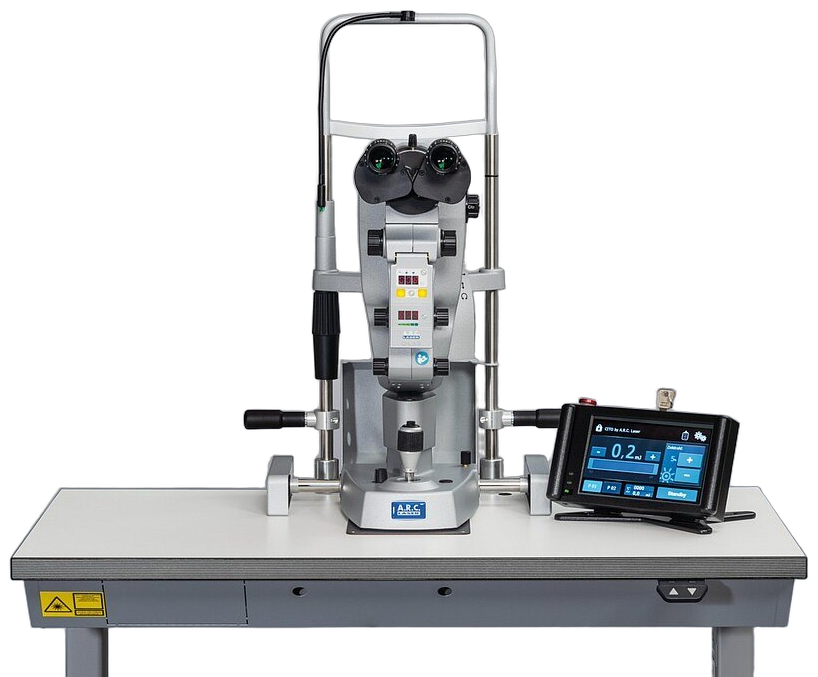
A.R.C. Laser · combined YAG and SLT laser

A.R.C. Laser COBRA : COBRA

One station. Two lasers.

A.R.C. Laser COBRA – combined YAG and SLT laser

Highlights.

SLT in trials

Fewer drops. More eyes at target pressure.

In a trial in Tanzania, SLT succeeded in 61% of eyes versus 31% on timolol at one year. These trials used other SLT lasers.

Kilimanjaro, Tanzania, at 1 year

  • Timolol31 %
  • SLT61 %

LiGHT, United Kingdom, at 3 years

  • SLT, drop-free74 %
Sources: Philippin et al., 2021; Gazzard et al., 2019. Results depend on each glaucoma; a third of SLT eyes in Tanzania had a second session.

SLT

The trabecular meshwork, shot by shot.

The green beam covers the angle shot by shot; only pigmented cells absorb the energy: that is the selective principle.

slowed down; actual rate up to 10 Hz
Diagram of the unrolled angle, as in gonioscopy.
400 µm
spot
0.2–2.0 mJ
energy
10 Hz
rate, up to

YAG

Focus posterior to the capsule. The IOL spared.

Two aiming beams converge; the focus can be shifted 150 or 300 µm posteriorly.

0.5–10 mJ
energy
< 10 µm
spot at focus, in air
1 to 3
pulses per shot (burst)
implantcapsulefocus, 150 µm posterior
Principle diagram. 1,064 nm infrared, invisible: conventional colour.

Installation

A room at 18–28 °C.

The COBRA operates between 18 and 28 °C, below 75% humidity and below 2,000 m altitude. Air conditioning is part of the installation.

18–28 °Croom temperature

51 kg
with table and slit lamp
72–94 cm
table height
CE 0123
class IIb

COBRA, or another A.R.C. laser?

Anterior segment, side by side.

COBRA

Laser
YAG 1,064 nm and SLT 532 nm, one slit lamp
Energy
YAG 0.5–10 mJ; SLT 0.2–2.0 mJ
Spot
YAG < 10 µm; SLT 400 µm
Procedures
Capsulotomy, iridotomy, SLT
Weight with table
51 kg
Laser
YAG 1,064 nm
Energy
0.5–10 mJ
Spot
< 10 µm
Procedures
Capsulotomy, iridotomy
Weight with table
44 kg

Learn more : Q-LAS

Sources: A.R.C. Laser (product pages, COBRA manual 2024, 2025 brochure).

Specifications.

YAG (Q-LAS)
Laser
Q-switched Nd:YAG 1,064 nm, diode-pumped
Energy
0.5 to 10 mJ
Spot
< 10 µm at focus, in air
Burst
1, 2, 3
Focus offset
0, 150 or 300 µm posterior
Aiming
635 nm diode, two beams
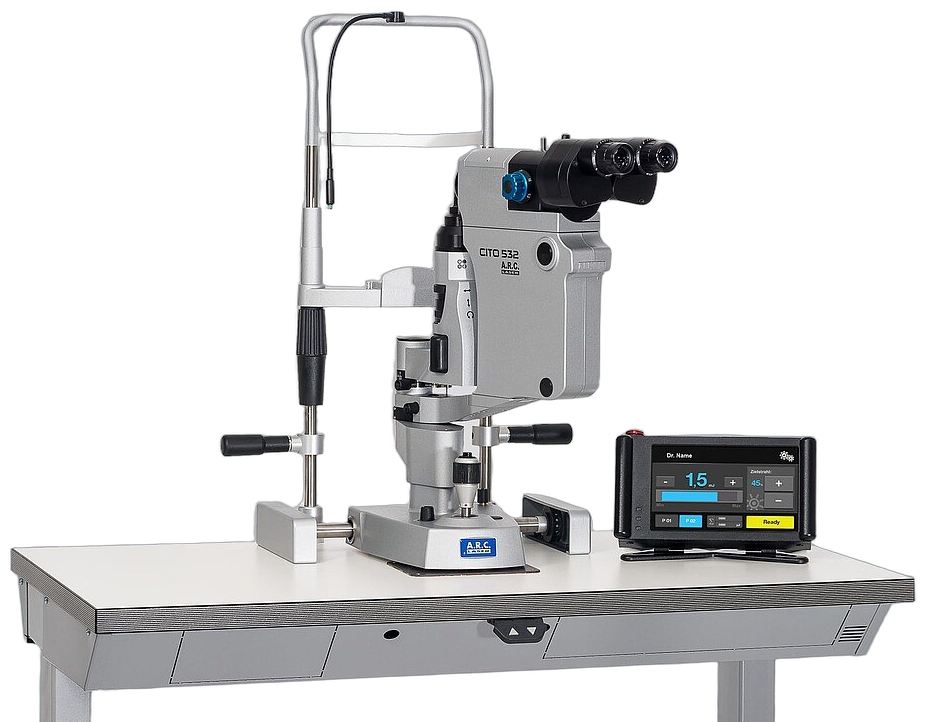
SLT (CITO 532)
Laser
Frequency-doubled Q-switched Nd:YAG 532 nm
Energy
0.2 to 2.0 mJ
Spot
400 µm
Rate
Up to 10 Hz
Screen
Touch, 7 inches
Station
Table
Two motorised columns, 72 to 94 cm, wheelchair accessible
Optics
5 magnifications, 6.3 to 40
Weight and size
51 kg; 130 × 69.2 × 58 cm
Power supply
100–240 V, 50/60 Hz, 400 VA
Room
18 to 28 °C, < 75% humidity, < 2,000 m
Class
Class 3B laser; CE 0123, class IIb

Sources: COBRA manual rev6 (2024), A.R.C. Laser pages. Specifications subject to change.

  1. SLT trials: Philippin et al., 2021 (Tanzania); Gazzard et al., 2019 (LiGHT). Performed with other SLT lasers.

In detail.

The whole anterior segment, one station

The COBRA combines SLT for glaucoma and YAG for capsulotomy and iridotomy, in a single slit lamp.

Installation, training and service

Emetrop Afrique supplies it, installs it, trains teams and maintains it across West and Central Africa.

Frequently asked questions.

How do you switch from YAG to SLT?

The two lasers are independent, in the same slit lamp: a rotary knob switches from one to the other.

What installation conditions?

An air-conditioned room between 18 and 28 °C, below 75% humidity: above 28 °C, the device may shut down for safety. We check the room before installation.

Who installs the COBRA and trains the team?

Emetrop Afrique: installation, settings, training of ophthalmologists and nurses, then maintenance.

How much does it cost?

It depends on the version and accessories. Ask for a quote: it is free and without commitment.

Images: A.R.C. Laser · Diagrams by Emetrop Afrique

See the COBRA at your site?

We bring it and show it to your team. No commitment.